
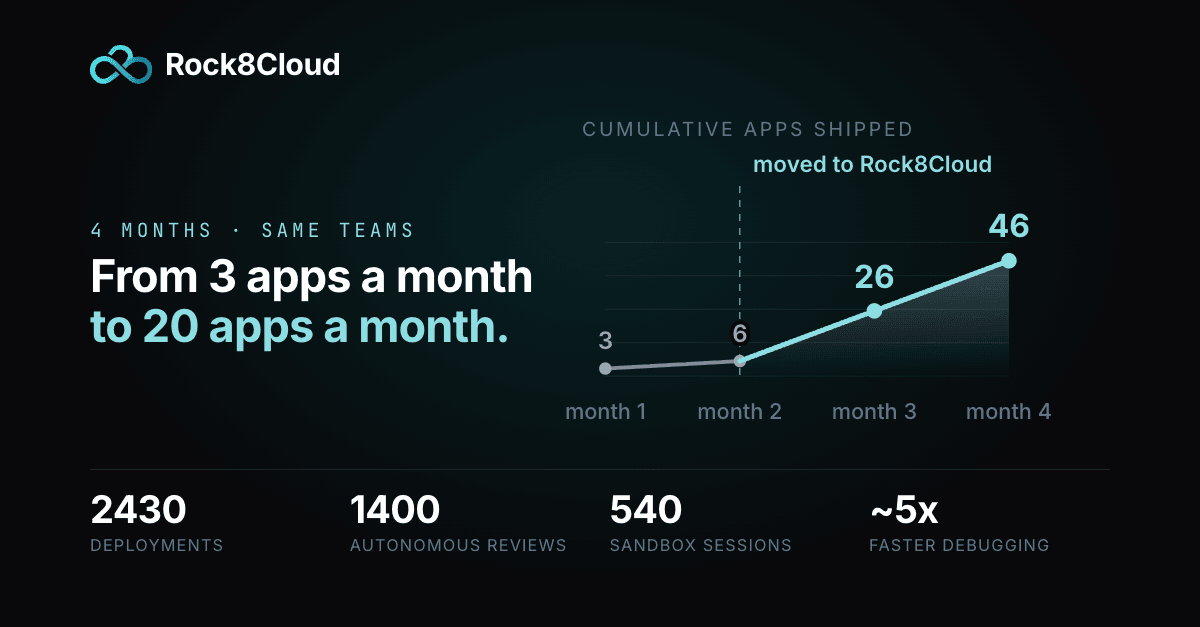
The value of coding agents is not the code they generate. It is how much faster a team can test, ship, and improve a product.
Before Rock8Cloud, our teams shipped about three apps a month. In the two months after moving onto the platform, they shipped nearly 40. That works out to 20 apps a month.
The point is not that we suddenly wrote roughly seven times more code. We built a toolkit around the coding agent. We made local coding agents more productive by giving them an execution loop, not just a sandbox. They could delegate bounded work, deploy a shareable preview for a customer without touching production, read the app’s build and runtime logs, and fix problems against the evidence. The developer’s main agent kept the product context while delegated work ran in parallel.
For some proofs of concept, we did not run the environment locally at all. We used the coding agents developers already work with, pushed changes through Git, and tested each version in a remote POC environment. Blueprints gave us more than infrastructure. They gave us a repeatable, battle-tested coding stack with the services and wiring already in place. The agent did not have to recreate the same application structure or infrastructure every time. That kept its context focused and avoided spending tokens on repeated setup. It also kept service wiring and production boundaries consistent, so we could build on a promising POC instead of starting over. Switching projects became less disruptive too. Developers could move to another repository without tearing down and rebuilding a local stack.
This is our own before-and-after, not a benchmark. The people, clients, and standards stayed the same. The deliberate change was the toolkit around our coding agents: secure delegation, repeatable environments, and platform context they could use to deploy, review, and debug.
The coding agent needed a platform#
A coding agent can change the code quickly. It still needs a place to run that code, a preview to share, logs to inspect, and a safe way to delegate the next task. When those capabilities are disconnected from the agent, the developer has to stitch them together by hand.
Our goal was not to make the developer disappear or replace their workflow. It was to enhance what developers and their agents can do with primitives that remove friction, while keeping production inside clear boundaries.
Managed services such as PlanetScale and Supabase for databases, Trigger.dev for background jobs, and similar products solve real problems. They are the right choice for many teams. Our bet is that most projects do not need a separate managed or proprietary layer for every building block. Postgres, Redis, object storage, and queues are open, well-understood components. We can provide the same convenience on top of them while keeping the stack portable and self-hostable, so moving to your own infrastructure does not mean rebuilding the product.
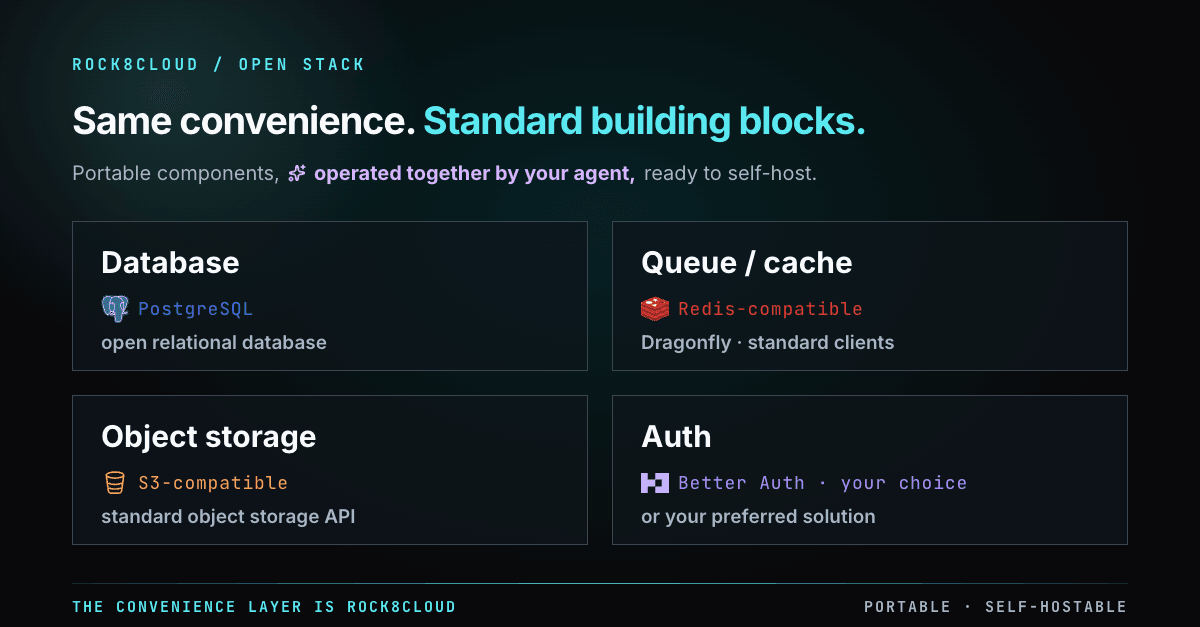
The boundary is not just access control. It is the interface. We abstract the infrastructure around deployment, databases, environments, logs, and rollbacks into scoped primitives exposed through one agent interface. Our platform gives the agent the tools to operate what it builds: deploy controlled previews, inspect running services, and keep iterating quickly within clear boundaries.
The boundary between exploration and the product stays explicit. Sandbox operations stay in the sandbox, while merging remains human controlled.
That is the value we got from Rock8Cloud. Not more lines pushed. More useful agent iterations per developer.
Deployment: we started by making shipping easy#
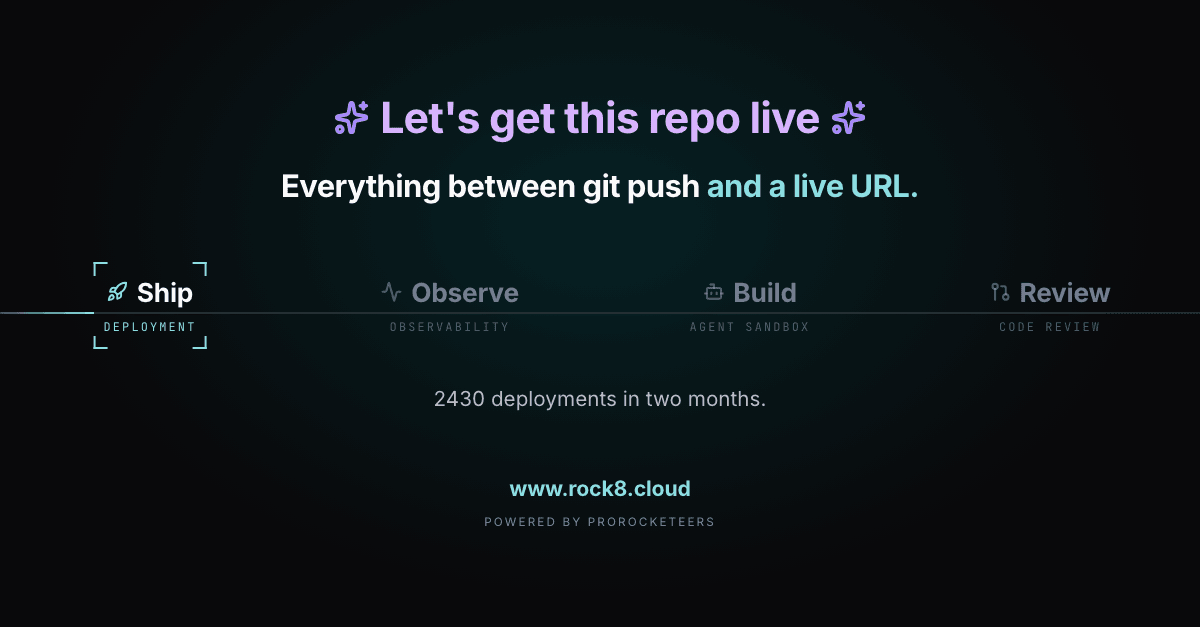
Getting the whole stack running was our first bottleneck. Every new app followed a similar DevOps sequence, but each stack brought its own configuration and edge cases. Provision the database and services. Configure environments. Build the pipeline. Wire everything together. One to three engineer-days disappeared before the idea even had a URL.
We solved it by putting the complete stack behind one deployment workflow. Rock8Cloud provisions its services, runs the builds, wires the environments together, and gives the app a URL. That convenience does not depend on a proprietary runtime. Application services use standard Dockerfiles, so the same containers can run elsewhere.
During those two months, we ran 2,430 deployments. The number is not the goal. It shows that deployment stopped being a separate infrastructure project and became a routine part of testing an idea.
Push a branch and get a preview URL a customer can open. Push to main and the app is live. Provision services when needed, roll back with one click, and run the same workflow from the UI or let an agent operate it over MCP.
Watch the complete workflow on the Deployment platform page.
One prompt replaced one to three engineer-days of repetitive setup. Ideas reached customers sooner, and developers could keep iterating without waiting for infrastructure work. Once an agent could ship the whole stack, we wanted it to understand what happened after deployment.
Logs & Health: more shipping meant understanding what was running#
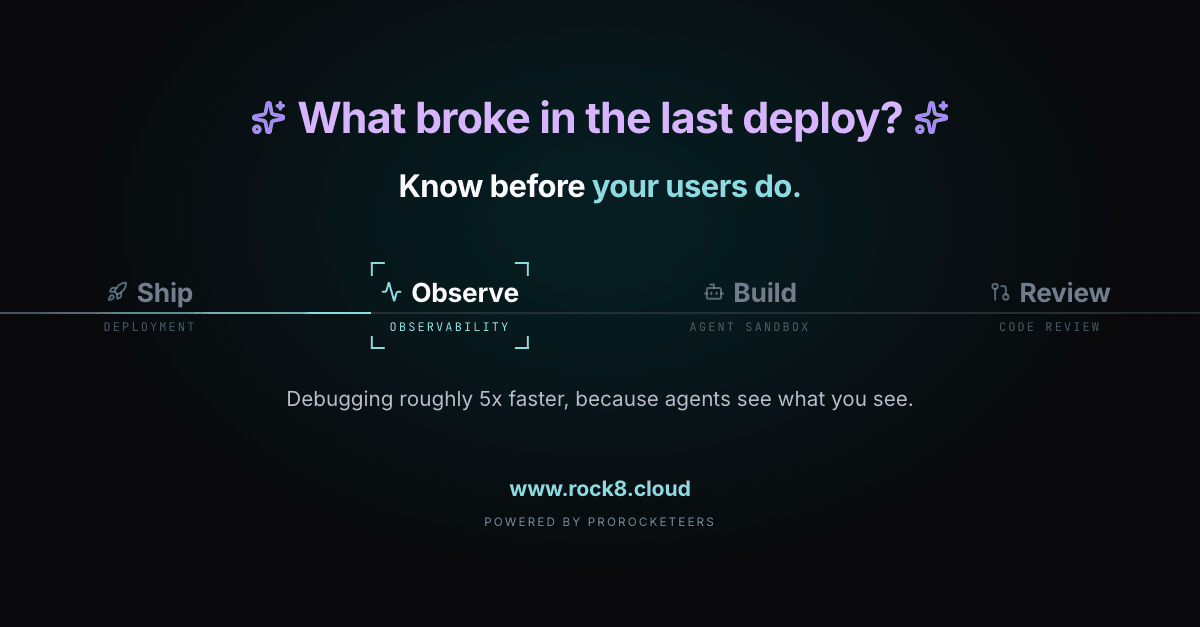
That required more than access to a log stream. Developers can inspect build output, deployment history, the running version, and runtime logs in the Rock8Cloud UI without switching between dashboards. The larger gain came from exposing that same context through the interface the agent used to ship.
The coding agent already knew the repository. LLMs are good at reading logs and tracing failures through a codebase. With the deployed version, build output, and runtime logs one prompt away, the agent could trace what broke back to the actual code instead of guessing from a snippet. Developers no longer had to collect evidence and paste it into a chat.
That unlocked a straightforward, secure iteration loop. A coding agent can trace a failure through the codebase, implement a fix, and push it to a feature branch. It can then watch the preview logs to verify the result and continue from the evidence, all within scoped platform operations.
This is the one number we will not present as a measurement. Our estimate is that debugging became roughly five times faster. We did not run a controlled benchmark. That is our honest read after using the platform on real work.
Once one agent could operate this loop, the next goal was to move more implementation work forward in parallel while developers stayed focused on product decisions.
Agent sandbox: delegated work stopped waiting#
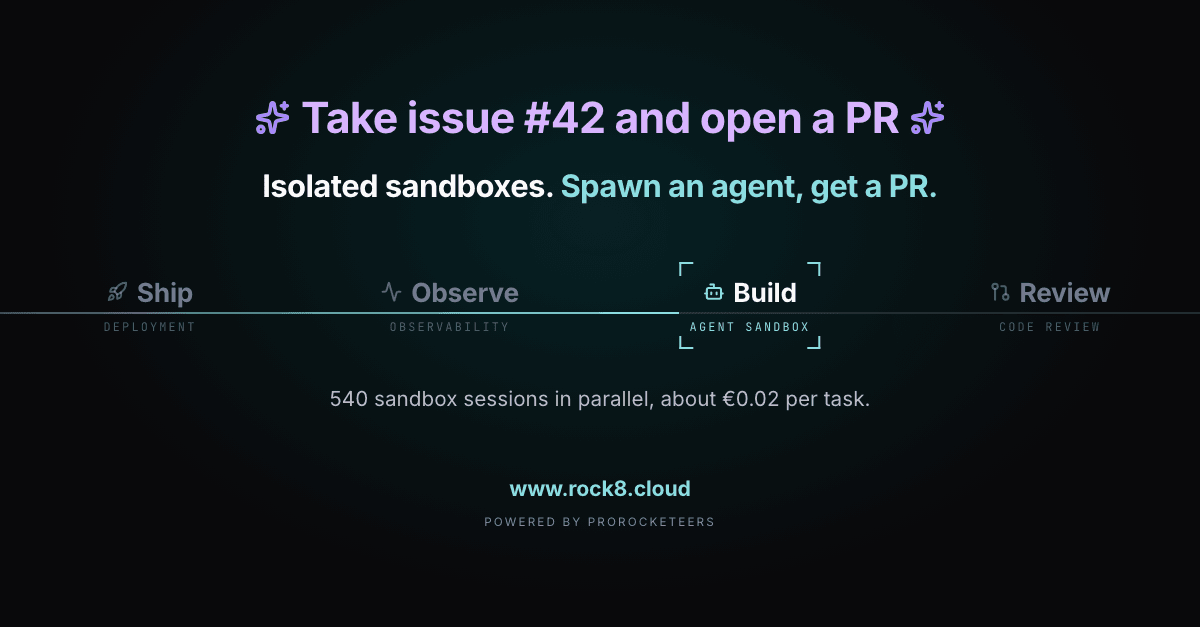
Parallel agent work ran into two local limits. Worktrees help separate code changes, but larger projects quickly hit hardware and workspace-management limits. Multiple agents still compete for CPU, memory, and local services. At the other end, every product has a long tail of small tasks that linger in the backlog because preparing another checkout and environment can take longer than implementing the change.
We built Agent sandbox to move those tasks off the developer’s machine. Each delegated task runs in an isolated remote workspace with its own checkout and a lightweight coding-agent harness optimized for efficiency. Users can run each implementation task with their preferred LLM, balancing capability and cost based on the work. During the measurement period, we ran 540 sandbox sessions. The average total cost was €0.02 per task. At that cost, small fixes and improvements no longer had to justify local setup. They could move forward in parallel and compound into better products.
Implementation tasks were only part of the value we found. We also used agents constantly to analyze repositories, gather context, and compare approaches before changing any code. That led us to add a read-only research mode to Agent sandbox. A research agent can explore the codebase, answer questions, and continue the discussion across multiple turns, but it cannot modify the repository.
Through our MCP primitives, any connected agent can start a research or coding session. Lower-cost models can handle context gathering, while stronger models can take on implementation. Developers can use these capabilities from the client they already prefer, whether that is Claude, Codex, or a connected mobile app. In practice, it puts the whole codebase in their pocket.
Parallel implementation only works when the handoff stays controlled. The sandbox agent can change and test code, but it never gets credentials to the real repository. Rock8Cloud takes its work, pushes the branch and opens the pull request. The developer reviews the result and decides whether it merges.
Code review: more pull requests needed a faster first pass#
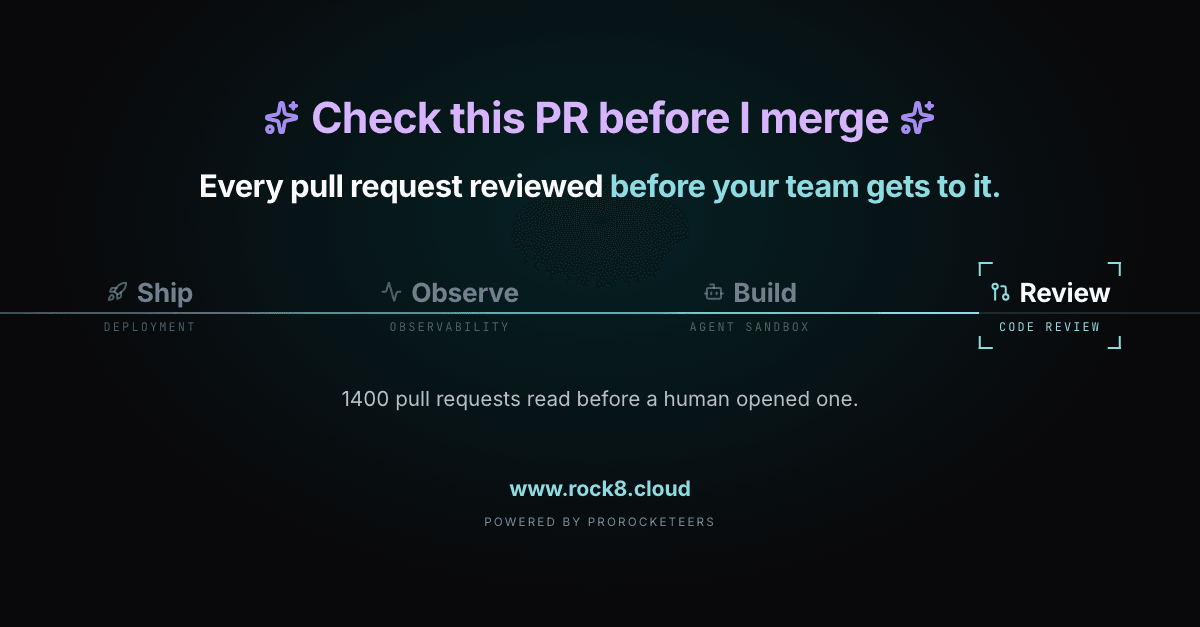
Code generation accelerated everywhere, not only inside Agent sandbox. Developers, local coding agents, and delegated agents all produced more pull requests. We needed a better first pass that helped developers focus their attention on the changes that required judgment.
That led us to build autonomous code review directly into Rock8Cloud. It fills a role similar to CodeRabbit, but shares the same platform context and workflow as Deployment and Agent sandbox.
Visual review is central to that workflow. Rock8Cloud renders architectural changes, database schema updates, and API endpoint changes as clear visual views instead of burying them in thousands of lines of diff. It also highlights bugs, security problems, and high-impact findings so developers can focus their judgment where it matters. From the same UI, a finding can be handed directly to a sandbox agent to investigate and fix. See the complete visual review workflow.
We recorded 1,400 autonomous reviews during the measurement period. Today a review costs about €0.06 on average, model usage included. More telling than the number was what engineers started saying: “Let me wait for the Rock8Cloud review” and “Nice catch.” The reviewer became the first safety net on every pull request before human judgment began.
Autonomous review gave engineering judgment a better starting point. LLMs are already good at writing individual functions, but the hardest review questions live above the function level: how a change affects the architecture, data, risk, and product intent. Developers could focus on those system-level decisions instead of giving every changed line the same attention.
The idea queue started moving#
Every business has a queue of ideas that seem promising but never become urgent enough to justify the development effort. With Rock8Cloud, we could turn more ideas into working software faster and at lower cost, whether they came from us or our customers. It made custom solutions viable for opportunities that previously could not support traditional development costs, letting us improve more parts of our customers’ businesses.
That changed how we decided what deserved further investment. Instead of debating an idea in the abstract, we could build a working version and put it in front of a real user. Their response determined whether we continued or stopped.
Most of those experiments will not survive. That is the point. Finding out in one week that an idea does not solve the problem is useful evidence. Reaching the same conclusion after five weeks of development is an expensive way to learn the same thing. The ideas that do survive do not leave us with throwaway prototypes. They are already built on portable, enterprise-ready stacks that can move toward production and scale without a ground-up rebuild.
Put your idea queue in motion#
Your coding agent already writes code. Rock8Cloud gives it the operational layer to turn that code into working software, runtime evidence, delegated implementation, and reviewed changes. Developers keep control while more work moves forward.